
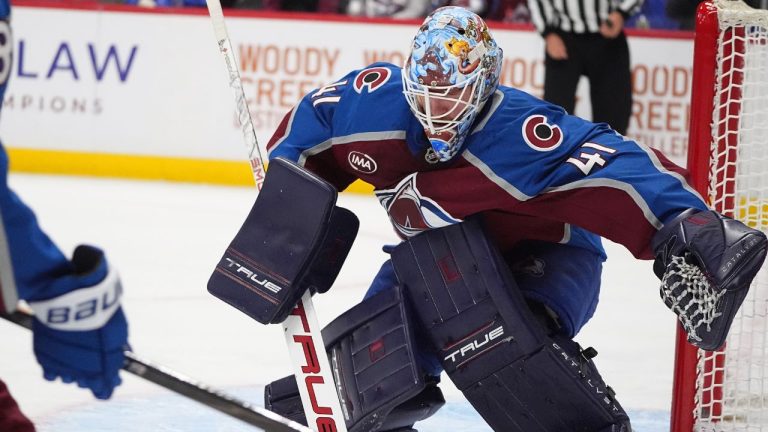
I’m truly intrigued. Are we witnessing a new trend? An increasing number of teams used an alternating goalie system during the regular season.
I remember Martin Brodeur’s claim (was it last year or the year before?) that the goalie position had changed tremendously in the modern NHL. Brodeur was explaining that today’s goalies are better than in his time, despite boasting lower stats. According to Brodeur, this is because the “game” in front of them has changed a lot as well… so much so that today’s goaltenders are subject to a more intense workload. He also mentioned that, for this reason, he developed an interest in alternating goalie systems and thought the league could migrate to such systems in the near future.
I was keeping an eye on both Jarry and Skinner after the Penguins-Oilers trade and noticed that after the Penguins acquired Skinner, they used Skinner and Silovs in almost perfect alternance. Regardless of the opponent, or number of rest days, it was Skinner – Silovs – Skinner – Silovs…
Similarly, the St. Louis Blues used Binnington and Hofer in (almost) perfect alternance this year. Hofer played 46 games, collecting 24 wins in the process (SV% .910). Binnington played 41 games for 13 victories (SV% .873). But this case was different: I wondered if the choice to resort to an alternating system was due to Binnington’s disappointing stats or if it was planned from the beginning.
The NHL being a copycat league, I wonder how many will notice that the two best teams in the league, the Colorado Avalanche and the Carolina Hurricanes were also rotating their goalies.
I do not need to belabor on Colorado’s phenomenal year… They were the best team in the league throughout the regular season and just dominated the Western Conference with a stellar .738 points percentage. Yet, the Avalanche were using Wedgewood and Blackwood alternately.
The best team in the East, the Hurricanes, also implemented a perfect rotation between their two goalies, Bussi and Andersen.
Again, the NHL being a copycat league, I wonder if other teams will take note and implement similar systems next year. Or was this year different? Was the choice influenced by the intense schedule imposed by the Olympics break?
Arguably, the most significant question is: how much did the rotating goalie system contribute to the success of the Avs and Canes?
Some, like me, will say it is something to explore.
Others will argue that it was probably negligible.
Dr. Seper Ekhtiari, an arthoplastic surgeon at the University of Toronto, published an article last year demonstrating that there is no link between goalie performance in the playoffs and their workload in the regular season. Ekhtiari analyzed goalie statistics for the last 6 seasons. He observed that the number of goals allowed in the playoffs by a goalie, their save rates, and goals-saved-above-averages were not improved after a lighter task in the regular season. Thus, the conclusion was that there was no correlation between “the task” and “goalie performance”. Although the study did not pertain to alternating goalie systems exclusively, it can be construed to suggest that goalie alternance should not provide any significant advantage.
I remain unconvinced. I would be curious to spend a bit more time and scrutinize the data used in the study. This is because I can envision many confounders and/or scenarios that could explain why a potential association was masked. I believe that as more teams adopt a true alternate goalie system, this study should be revisited with more reliable data. Colorado and Carolina’s performances certainly support this.
Food for thoughts…
*Load Management Among Professional Hockey Goalies: A Retrospective Cohort StudyDOI: 10.1177/19417381241271556